Pages

Thursday, December 9, 2021

How to Teach Kids to Find the Main Idea


You shouldn't.

Sort of.

Well, let's start at the beginning.

First of all, what is a main idea? Tim Shanahan has written at length about it here, but for our purposes we'll define it as the big ideas an author is trying to convey, whether in a section of text or an entire work. It's different from a gist, in that a gist is a first initial reaction to what you think a chunk of text (or the text as a whole) is about, while a main idea is the actual idea an author is communicating. Your gist may not be correct at first, because it's a surface-level skim of what a text is about, but the main idea should be correct because it can only be determined after a careful analysis of the text in question. (I've blogged about the difference between gist and main idea here.) In general, it's synonymous with central idea. And, in general, its counterpart in literature is theme. 

(Let me issue a word of caution about getting too granular with the standards. These aren't legal documents, and we shouldn't approach them legalistically by making fine distinctions or closely analyzing the words. It's also important to know that these terms are treated very broadly and often interchangeably in the materials students will encounter. So, it's best to keep these terms more general for kids.)

Second, what is a main idea NOT? (Bad grammar, I know, but let's go with it.) 

Determining the main idea of a text is not a skill that can be learned, mastered, and then applied to a different text.

There is no research that supports that idea that there is such a thing as a set of transferable "comprehension skills" that can be mastered and then applied with a new text. And our standards tend to be treated just like that ... a list of skills to be mastered one at a time, with the idea that once kids can do these things, they will be prepared to use them to understand other texts. (Strategies are another thing - though not too different - and I'll tackle that topic in another blog post.) Thinking about main idea specifically, we can encounter an author's big idea in really different ways in really different texts; determining the big idea an author is saying isn't a highly repetitive act, and there are no tricks to make it repetitive.

If I'm being REALLY honest, that idea blew me away when I first encountered it, and I rejected it because teaching comprehension skills is what I had been told to do - by my professors in my program, by the basal materials I used early in my career, and by some well-meaning literacy folks I turned to. And as a profession, we've been teaching this way for a very long time ... some 30 years or so. But we've got about 1/3 of our kids nationally reading on grade level, and we've been there for about ... 30 years.

When I thought about it, this idea confirmed what I saw in my own classroom. When I would get some set of data back, I'd typically identify my lowest standards and focus heavily on those specific ones, treating them as "skills." We'd practice them repeatedly until I thought they had it. But when it came to testing time and a fresh, long, and complex text, they never did, because it's not a skill that can transfer.

So, why do we even talk about determining main ideas or central ideas or themes? Well, because if a student can tell us the big idea an author is trying to convey, that's a very good indicator that the student has a certain level of understanding about the text that they are reading. (That is, after all, the whole point of what we're doing.) And the role of standard 2 is to help us understand how deep or how sophisticated that big idea should be when we hear a student share it.

Let me give you an example I've heard recently. A teacher was teaching with a text about World War I. A student was really struggling to determine the main idea of the text, and so the teacher sat and worked and discussed and taught. Finally, that student was able to select the correct main idea and supporting details. Then, the teacher asked, "So, what was the primary cause of World War I." The student looked back and replied, "I dunno."

But guess what. That had been the main idea! The main idea of that text had been the primary cause of World War I, and the student had (finally) been able to determine that ... but then he had completely missed the point and an understanding of the text. Could he find that main idea? Maybe. Had he understood what the author was trying to say? Certainly not.

So, what to do?

There are some research-based ideas that we can use as guidelines to help kids comprehend complex texts better, and as a result be able to understand the big idea an author is sharing. Borrowing from Shanahan, here are 5 big ones:

1. Teach students to find the gist and summarize. This is a strategy that has a good bit of research behind it. And if you think about your own reading, when you're absorbing something meaty and complex, you likely stop every now and then to think about what you've read so far. I've even borrowed professional books from friends who write their own quick synopsis at the end of each chapter. If we can summarize a bit, we are getting closer to that key idea an author is sharing.
2. Chunk it up. Start by summarizing a paragraph or few first, showing kids how to identify the important ideas, delete trivial or repetitive information, and paraphrase the key point in a single sentence. Then, move to longer chunks of text.
3. Use gradual release of responsibility. Model how you think about a paragraph, cross out trivial information, paraphrase, and think through to the essence of what an author is trying to communicate. 
4. Read this way widely. Vary the text type, topic, difficulty, length, etc. Give them lots of practice to think in big idea ways, always asking, "What is the author trying to tell me here?"
5. Rank the ideas. Any text at a complexity for 4th grade and above (and often lower) will have multiple main ideas. As students think about these big ideas an author is communicating through their work, have them rank them in order of importance to the text as a whole or the quality of the evidence that an author is using to support it, explaining their thinking and their reasoning.

And always, always, always focus on making meaning of the text. The whole point of literacy instruction is to prepare students to glean knowledge or understanding from a fresh, complex text independently. We want them to constantly ask themselves while they're reading, "What's important here? What's the author saying to us? What am I learning? What is important for me to remember?" The more kids get the chance to do these kinds of things with a whole lot of different texts, the better they'll do overall.

Because it's not that we teach them to determine the main idea so they can understand the text. We teach them to understand the text so that they've understood the main idea.

Want to read more? Check out Tim Shanahan's blog post about teaching main idea here and piece from Edutopia here.

Here's to simply teaching well,

Monday, December 6, 2021

Six Ways to Improve Turn and Talk


If I'm being perfectly honest, turn and talk has typically been one of those things I pull out of my back pocket when I get the blank stares from my kids or it gets weirdly quiet in a discussion - especially if there's an "observer" in my room.

It'll go something like this.

Me: "Okay, based on the character's actions and feelings, do you think she's a Loyalist or a Patriot?"

Kids: *Blink, blink

Me: *Scan the room and pray for a good response in the middle of my observation. Try to make eye contact with the kid who can always pull out something but they look away.

Kids: *Blink, blink

Me: "Okay, let's turn and talk."

And sometimes it works, and it kind of primes the pump of the conversation to get it going. Which is fine. 

But sometimes, it feels like a filler in my lesson that I plopped in because it felt like it needed something - that little dash of hot sauce on top of the chili - but not necessarily because it was just the right instructional move at just the right time. I know this is the case when the kids' talk is surface-level, or not 100% on topic, or when they talk for just a second and then stop. Then I wonder, should I have given more wait time, or asked everyone to write, or asked a clearer question instead?

To move turn and talk from being just a thing to being just the right thing, here are a few moves you can make:

  1. Post a good question where it's visible. It may seem obvious, but give them a thoughtful question to really respond to. Instead of "What do you wonder about this?" try "What is new information to you here?" or "How does this build on what you already know?" or "What might someone disagree with here and why?" And always post it so it's visible. With turn and talk, the room can get loud and kids are having to take turns, and that can overwhelm some brains. Posting the question on the board gives them a place to go back to and remember what they're actually supposed to be talking about.
  2. Give time to process. Give the kids a heads up that a turn and talk is coming and then give them some time to think before they have to talk. Odds are that about 50% of your kids will be more introverted and need a bit of time to collect their thoughts before they interact with someone else. Try, "Here's your question. In a minute, I'm going to invite you to talk to your partner about this question. I'll give you a minute of quiet think time to consider what you want to say and how you'll listen."
  3. Set up partners or triads early. I have probably wasted hours of classroom time in coming up with cute ways to pair my kids up. "Who's peanut butter? No, Charlie, you're jelly. Brayden, your jelly partner is missing today, so find another one. There isn't one. Just join another group. I don't care if you're jelly or peanut butter - just talk to them, please." It's best to keep this super simple and adaptable for when kids are out. Try elbow buddies, row buddies, or anything else that takes less than 15 seconds to organize and get going.
  4. Have a standard in-cue and out-cue. Have one standard, verbal (and/or non-verbal) cue that lets students know it's time to talk and it's time to stop. A simple one could sound something like, "The question to talk about is on the board. Take a moment of quiet time to think of your response. And we'll talk in 5 - 4 - 3 - 2 - 1." When it's time to bring them back together, give them a minute or so of warning and bring them back with the same countdown. 
  5. Use your out-cue at the crest of the wave. Often, we wait until the turn and talk conversation fades a bit so we're certain they've finished, and then we bring them back to the whole group discussion. Instead, try bringing them back when they're not quite finished - when they're at the top or crest of that discussion wave. Doing so can help bring that discussion energy productively back to your whole group discussion.
  6. Try Everybody Writes instead or in addition to. Instead of so much turn and talk, try this strategy from Teach Like a Champion, where you give kids time to write their responses to a question or prompt. It takes about the same amount of time, gives kids independent time to think and process, and makes their thinking visible to you. Or, if you see that some ideas need to be fleshed out through discussion, you could do Everybody Writes and then have students turn and talk about it what they wrote.
And always know why you're using your turn and talk strategy. If it's a filler or just a way to get some discussion going, consider whether there's something else you need to do - or whether you just need to let a question sit for a bit. On the other hand, if partner discussion is just the thing that's needed for kids to process, press in on their thinking, practice some speaking and listening skills, or even rehearse writing, then maybe turn and talk is perfect. Either way, know exactly why you're using it before you do so you're making the most of every instructional minute you've got.

Here's to simply teaching well,

Friday, December 3, 2021

Hexagonal Thinking


Jennifer Gonzalez from Cult of Pedagogy wrote about hexagonal thinking recently, and it's a powerful way for kids to consider the connections between ideas and nuances in word meaning as they're exploring a topic of study. 

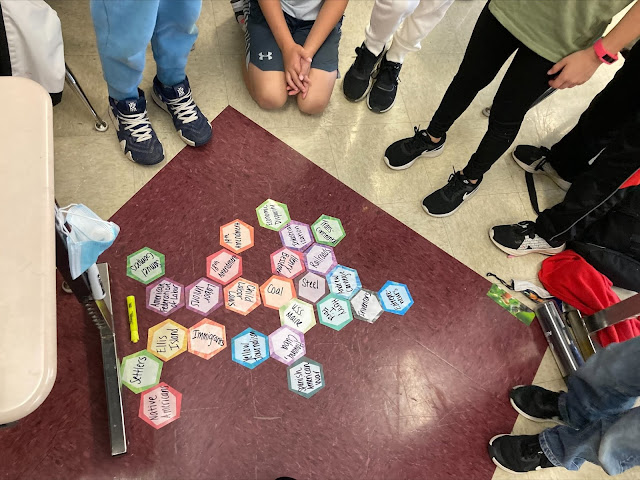
Fifth grade teacher Stephanie Fontaine at Siegel decided to use it in her classroom as a way to review some work in social studies, and I want you to look at the connections her students made between ideas as disparate as immigration, Ellis Island, Henry Ford, yellow journalism, labor unions, and constitutional amendments. 

This may seem very similar to concept maps, and you wouldn't be wrong. But the nature of a hexagon means you've got multiple opportunities to connect ideas or concepts in ways that can be very close or farther apart. And you could give the same set of hexagons to different groups of kids, as Stephanie did, and the connections are going to be different every time. Because while the connections are important, it's the conversation, thinking, justification, explaining, and attention to precision behind those connections that develops the habits of mind our students need. 

Hexagonal thinking can be used in any subject area - or across them - to really push student reasoning and logic. You could introduce hexagons at the beginning of a unit of study, and adjust the connections as you go, or use them at the end to review and solidify thinking as Stephanie did. You could also leave the hexagonal connections posted in your classroom throughout a unit and ask students to write out their justification for or disagreement with specific connections. There are SO many possibilities for deep, critical thinking with this. 

Shapes and words in the hands of a skilled teacher and eager students. What a beautiful thing.

Here's to simply teaching well,

Thursday, December 2, 2021

Attending to Precision


It may sound like a mathematical practice - because it is - but I will argue that attending to precision is a critical literacy practice, too.

Take, for example, an assessment you're going to give to your students. When you take that assessment yourself, consider not just the correct answer and how students will have to think to choose it. Also consider the most common wrong answer you'll get and how students need to think to NOT choose it. What you'll find almost every time is that students need to do things like read the entire question, read all of the answer choices, think carefully about precise word meanings, read every part of the word (even the ending), pay attention to all of the punctuation, make sure the answer is fully correct. In short, they have to attend to precision.

I'll also argue that it's easy to let precision slip. There is such a sense of urgency about the work in the classroom - there is so much to complete, and so many things that need our time and attention - that it's easy to go light on precision. But pressing for precision is one of those habits of mind that's like a rising tide - it'll lift a lot of ships.

One habit you can foster that will help students attend to precision is what Doug Lemov calls "Right is Right." As he writes, 

"Right is Right is about the difference between partially right and all-the-way right - between pretty good and 100 percent. The job of the teacher is to set a high standard for correctness: 100 percent."

It sounds simple, but here's what it can look like when we let this slide. 

Let's say that I'm teaching with the book The Boy Who Harnessed the Wind. I ask the kids how William used design thinking in his solution to providing access to water, and one student says, "He designed a windmill." It's not wrong, but it's not all the way right, either - it's only partially correct. And a couple of things can happen here. I might say, "Yes, that's right," and then move on to another question. Or I might do what Lemov calls "Rounding Up" and say, "Yes, he did design a windmill, and he did it by first identifying the problem, doing some research, and designing and trying out some prototypes before he arrived at a final solution." Basically, I have "rounded up" the student's answer and I have done the thinking and speaking that they should have done. 

There are a few ways in which students will give you not-100%-correct answers:
  • A partial answer: As above, they started a correct answer, but it's not fully developed.
  • Answer a different question: A student may do this when they don't know the answer or don't understand the question. If Katie's confused about William's design thinking, she might say, "His windmill was really important to the people in his village, and it showed how much he cared." It's not wrong, but it's not an answer to the question you asked.
  • A non-answer: A student might also give you an example rather than an answer. For example, Katie might say, "Design thinking is when you go through the steps of the design process to arrive at a solution." That's an example of design thinking, but not how William used it.
  • Right answer, wrong time: A student might get ahead of you and answer a question a few steps down the road. Katie might have said, "William's design solved a critical problem and had a profound impact on his village, showing his empathy and commitment to community." Great answer, but you don't want to take the class there yet.
  • Imprecise vocabulary: Katie might say, "William designed that thing that spins to get water to his house." What's the thing? Can you use better vocabulary than spins? Was the water going to his house or to his village as a whole?
When students do these things - and when I pay attention, I see them do them all the time - we need to get into the practice of holding out for all-the-way right. Here are a few ways you can do that:
  • Know the ideal student response you're looking for: As you study the EL lesson, don't just study the questions - study the exemplar student responses, too. It's hard to know what all-the-way-right looks like unless you've thought about it beforehand.
  • Rephrase your questions: For hard questions, the first student answer is rarely 100% correct. So, try rephrasing some questions with stems like, "Who can get us started in talking about how frogs' behaviors help them survive in different environments?" or "Katie, would you kick this off by sharing some of the ways Jack is feeling in this part of the book?"
  • Ask for an add on: Say, "Good start; thanks for that. What can you add on to your thinking to get us closer?" or "Good start; can you get us the rest of the way?" or "Can you develop that?"
  • Press for specific details: Say, "Thanks for that answer. What specifically about William's work on the windmill shows design thinking?"
  • Press for more specific language: Say, "Thanks for that answer. Can you use a more precise word than X?" Or ask them to replace a pronoun in their answer with the noun it's replacing. For example, "Katie, you said, 'It was spinning.' What is the 'it' you're referring to?"
  • Pitch it to the group: "Katie gave us a strong start here. Who can take us another step?"
And if you want to see it in action, here's a video.

As I'm finding with most things in literacy, this isn't flashy or new or particularly innovative. It's just an old idea done very, very well.

Here's to simply teaching well,

Saturday, November 6, 2021

Reading Comprehension Isn't About Asking Certain Types of Questions


Recently, Tim Shanahan blogged about his top 10 pet peeves when it comes to teaching reading, and per his style, it took two separate posts (post 1 and post 2) to get them all in. His Pet Peeve #7 resonated with me most:

Pet Peeve #7: Teaching Reading Comprehension by Asking Certain Types of Questions

Here's what he had to say about it:

"Here is another issue that I get a lot of mail about. Principals (and sometimes teachers) are often seeking either testing or instructional materials that will allow them to target specific reading comprehension standards or question types from their state’s reading assessment.

Those requests seem to make sense, right?

They want to know which comprehension skills their kids haven’t yet accomplished and asking questions aligned with those skills should do the job, they presume. Likewise, having kids practice answering the kinds of questions the tests will ask should improve reading comprehension performance. Again, it looks smart. It seems like a great idea to have kids practice answering those kinds of questions they’ll have to answer on the state tests.

My mama told me that just because something seems right doesn’t make it right.

She was right in this case. There is no evidence that these so-called comprehension skills even exist. There is, in fact, considerable evidence that they don’t (Shanahan, 2014; Shanahan, 2015).

Study after study (and the development of test after test) for more than 80 years have shown that we cannot even distinguish these question types one from another. Likewise, there is no evidence that we can successfully teach kids to answer the types of questions used on tests.  

If you really want your kids to excel in reading, get them challenging texts. Then engage them in discussions of those texts. Get them to write in response to the texts. Reread the texts and talk about them again. Come back to them later to compare with other texts or have them synthesize the info from multiple texts for presentations or projects.

Ask them questions that are relevant to the understanding of those texts. Don’t worry about the question types. Worry about whether they are arriving at deep interpretations of the texts and whether they can use the information. Reading comprehension is about making sense of texts, not about answering certain types of questions."

I think Shanahan said it so well, and this is why I'm a proponent of putting the text at the center of instruction, not standards. Standards hold us to a common set of expectations for what well-educated students should know and be able to do by the end of each grade. They should be kept top of mind while planning and teaching students to plumb texts at the appropriate challenge. But the standards themselves are not the goal of daily instruction; understanding the text, gaining knowledge from it, and being able to express that understanding is. 

If you want to read more, Shanahan has (lots) more to say here and here and here.

Here's to simply teaching well,

Thursday, November 4, 2021

One Small Thing: The Complete Sentence


The work of teaching and learning is big, now more than ever, and teachers are feeling that pressure in big ways. Everything feels urgent and important and critical, and the challenges are complex, and the needs are many. And all of that "bigness" can make the work itself seem simply overwhelming. How do you know what the next right thing to do is when it's all coming at you so fast, and the solutions seem as big and daunting as the challenges themselves?

When I'm feeling that way, that's when I know it's time to turn to a One Small Thing. A very small tweak or change or adjustment I can make, easily and tomorrow, that can still create real change for our students. 

Today, that One Small Thing is: The complete sentence.


In Teach Like a Champion, Doug Lemov writes, "The complete sentence is the battering ram that breaks down the door to college." Yet, we know that writing good, complete, thoughtful sentences can be a challenge for kids no matter the grade level. 

One powerful practice you can adopt is to insist that students speak in complete sentences consistently so that they get plenty of practice in hearing, using, and attending to complete thoughts. That means that no matter the instructional format - classroom discussion, small group work, close reading questions - students express their ideas and answer questions in complete sentences all. the. time.

It can take an extra dose of patience at first, but I have seen this pay off big time when students begin transferring the skill of speaking in complete sentences to writing in complete sentences. And it will happen, but it takes daily, frequent, consistent practice.

Here are a few techniques you can use to prompt for complete sentences in your classroom:
  • Remind students before they start to answer. ("Who can tell me in a complete sentence what the setting of this story is?")
  • Provide the first words of a complete sentence, with the expectation that the student will use them to start his or her own ("The setting is ...")
  • Remind students with a quick and simple prompt after they answer ("Complete sentence.")
  • Use a nonverbal signal (Create a hand signal, such as bringing the fingertips of both hands together in an "A" shape to both remind students to use a complete sentence or to mark it when they do.)
It's one small but mighty thing.

Here's to simply teaching well,

Monday, November 1, 2021

Are You Fishing or Hunting?


I ran across this idea recently and I've been thinking about it nonstop since.

When I'm teaching, and I pose a question to the students, am I fishing for an answer or am I hunting for one?

Here's the difference.

If I'm fishing, I'm tossing a question out there to see what student responses crop up. I'm not really certain of what I'll hear or what I'm looking for. I'm casting my line and fishing for an answer.

On the other hand, if I'm hunting, I'm posing a question and I know exactly the ideal student response I'm looking for. If I hear it bubble up, I know we're good and we can move on. If I don't, I know how to press - what follow-up question to ask or the reteaching that might need to happen - to get a fully correct response from the students. I know my question AND I know the student thinking I'm looking for before I ever ask it. 

Now, I think there's a time for both. When we're looking for open discussion, some creativity, when we're building on some rich questions or ideas over time ... these are times when you might pose a question and fish a bit. But I think the idea of hunting with a question is critically important, and I just don't know that we do it enough. When we hunt with a question, we deeply know the purpose of the lesson, we know exactly what students need to learn from it, and we make the very most of every precious moment in our classroom because we can make real-time adjustments to our content in response. 

If you're looking to shift your questioning from fishing to hunting, here are a few next steps you can take:
  • Find an upcoming lesson with a sequence of questions that are already planned.
  • Review them and assess the balance of fishing and hunting.
  • For your hunting questions, write out the exact, fully correct student response you're looking for
  • Plan follow-up questions you can ask if you get blank stares or less than fully correct responses. Be careful not to give away the thinking.
  • Then think about 2 or 3 misconceptions you know students are likely to have that would lead to an incorrect or incomplete answer. Plan out the questions you can ask to move them past that misconception and toward a fully correct answer, again without giving the thinking away.
As with so many things in literacy, it's good, minds-on stuff that doesn't require a whole lot: A rich text, well-planned questions, and the relationship between a teacher and a student. Yet it's the most beautiful and powerful work I know.

Fishing and hunting.

Here's to simply teaching well,

Wednesday, October 27, 2021

Language Dives with Jamboard


Kayla Stephens, who teaches 5th grade at Salem Elementary, had a Language Dive success recently that was too good not to share. 

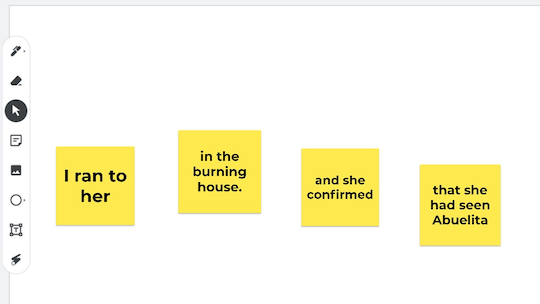
Instead of cutting out strips of the sentence and having the students arrange them in the correct order, she put the chunks on Jamboard and had the students arrange them using this digital tool. 

Turns out, Jamboard isn't just for collaboration. Kayla made a copy of a Jamboard for each student in Google Classroom, and each one will have his or her own board where they can work with the sentence chunks during the practice part of a Language Dive. 

Here's what it looked like when one of her students rearranged the sentence chunks in a different order than the original sentence, while still maintaining the author's meaning.


As an extension, students could add another digital sticky note under each of the chunks to restate it in their own words, and the collaborative nature of Jamboard means that students could easily work together if you prefer even while socially distanced.

This is an easy, low-prep alternative to using paper sentence strips during a Language Dive that is environmentally friendly, maintains the intellectual rigor of the work, AND will save you a bit on your copy count to boot.

What's not to love? Thanks, Kayla, for the share!

Here's to simply teaching well,

Sunday, September 12, 2021

Eat the Chicken Nuggets


When my middle son was little, I was distracted and in a hurry to get some dinner on the table one night. (Sound familiar?) I plopped him in his high chair, gave him a plate with chicken nuggets and sauce, and then busied myself with other things.

After a couple of bites of nugget, he started crying, and I couldn't figure out why. Nothing was hurting him, and there was nothing obvious going on - just a half-eaten chicken nugget on the plate. I encouraged him to take another bite. He did, made a face, spit it out, and started crying again. 

Frustrated, I was just about to call it a night and break out the back-up cereal, when I thought - what if there's something weird about the nuggets? They looked perfectly fine. But when I bit into one, I realized the issue ... they were still frozen solid in the middle and absolutely disgusting.

I always think about this story when I think about the power of teachers doing students' assignments themselves. It's an incredibly powerful practice, but in the busy-ness of planning, prepping, and teaching, it's all too easy to put it to the side. But we can learn so much from doing our own tasks, taking our own tests, completing our own note catchers, doing our own projects. When we do these things - when we eat the chicken nugget ourselves - we can better pinpoint where things might fall apart and prevent that from happening in the first place.

So, here are 5 ways you can eat the chicken nuggets in your own practice.
  1. Clarify instructions. Check the instructions on every assignment and make sure they are clear, concise, and complete. If the directions send students to a specific page number or tool, is it correct? Do they have those materials handy? Do your directions answer the questions you know students will inevitably have? 
  2. Clean up the format. When you do the assignments yourself, you'll see if the format needs to be changed. Do you need more space in a graphic organizer? Do lines need to be added? Is there too much room, and students will think they need to write an essay rather than a paragraph? Is the font the right size? Are there too many papers to shuffle through? It's amazing how much seemingly small things like these can impact how smoothly an assignment plays out - or doesn't.
  3. Identify likely misconceptions. Especially when you take an assessment, think about likely misconceptions students will have and how that may impact their answer choices. For example, if the student chooses B as the answer, but the correct answer is really C, ask yourself why she would choose that: What's the misconception that's leading her to choose B over C? And even more importantly, what do you need to say or do during instruction to clean up this thinking? 
  4. Maintain a beginner's mindset. Sarah Brown Wessling tells of the time when a student in her high school English class was having a hard time with an assignment for The Great Gatsby. Sarah struggled to help break the work down into chunks for the student because she had developed a high level of expertise with the novel and the assignment, and the student was a beginner. So, Sarah took her own assignment to the library and completed it with text that WAS challenging to her - Proust. This required her to adopt a beginner's mindset to her own assignment, and she found ways to scaffold the work better because of it. Doing student assignments yourself can help you adopt your students' beginner's mindset and be more prepared to break down steps or coach them through sticky spots. 
  5. Create an exemplar. Completing assignments - especially writing assignments - yourself helps to create an exemplar that you can refer to when teaching or assessing student work. And with EL materials, it's powerful practice to complete the assignments and compare your own work to the exemplar that is in the teacher supporting materials. How close did you come to ideal work? And what did you learn from that comparison that you can bring to your instruction?
Two more notes. You'll want to plan ahead so that you can complete assignments or assessments well BEFORE you're scheduled to teach the content. Wait too long to do them, and you won't have enough time to apply what you learn when you're teaching. And this is ideal work to do with colleagues during a PLC meeting. Bringing completed work to the table and comparing the clarifications and instructional moves you suggest with your colleagues is a huge opportunity to dig deep into content and learn together.

There's no denying that it takes some time to eat the chicken nuggets, but when you do, you'll find that instruction is clearer, assignments are smoother, and learning is deeper. 

And you can avoid a whole lot of tears. 

Here's to simply teaching well,

Thursday, August 19, 2021

Debunking "Learn to Read and then Read to Learn"


It's catchy. And if you've been in education for any length of time, you've heard this one. "First kids learn to read, and then they read to learn." And you usually hear this in relation to that jump from second to third grade, with folks saying that kids "learn to read" in kindergarten, first, and second grades through decoding and phonics instruction. Then in third grade there's a shift to "read to learn" that focuses solely on reading for information and comprehension and lasts through the end of their school careers.

I disagree. And I'm gonna get weedy about it.

A lot of this began in the early part of the 20th century, when children would practice letter-sound relationships and memorize spelling rules without any practice in a text. In the 1930s, the look-say method took hold and advocated for children learning whole words in basal readers and on flash cards. Then in the 1960s, the pendulum swung again with a heavy emphasis on systematic, explicitly taught phonics and comprehension was simply "caught" along the way. 

Through all of this, a couple of ideas took hold. One is that children have to learn to decode before they can comprehend. Another is that students stop decoding in second or third grade. It's as if you have these two very separate and hierarchical reading tracks that don't really cross.

Research over the past 20 years by folks such as Marie Clay, David Pearson, and others has debunked this idea.

What we've learned is that students can and should begin comprehending text as they begin to decode. In the early days, those texts may be very simple, but students can still understand the content and should be taught to attend to it. If we wait until third grade or above to attend to good, thorough comprehension, we have waited far, far too late. We've also learned that students don't and shouldn't stop decoding in second or third grade or beyond. Students - and especially those who struggle to read - need continued work in decoding and multisyllabic word work to become proficient readers as they progress through the upper elementary grades.

And if we want to get super, super weedy about it, I think we need to have a common definition of what we mean when we say "reading." To me, "reading" is more than decoding. It's the process of both decoding and understanding text to get meaning from it. Which is, after all, why we do this work. 

So, reading isn't built on two separate tracks that never meet. We don't learn to read and then read to learn. Reading well happens when two intertwined threads in the same rope work together from kindergarten to middle school and beyond.

Here's to simply teaching well,

Sunday, August 15, 2021

Close Readers Do These Things


It's no secret that there are a lot of anchor charts in EL. Like, A LOT. We need to create them judiciously so that we don't overload students (or the walls). But the "Close Readers Do These Things" anchor chart is an important one that I'd make and keep up all year long. 

Here's why.

First, the contents of the anchor chart are a set of 8 close reading strategies that are fairly brief, simple, and to the point. They are:

  • Read the text slowly, at least twice.
  • Get the gist of what the text is about.
  • Circle words you don't know
  • Determine the meanings of words you don't know by:
    • Using affixes and roots for clues.
    • Reading around the word (using context)
    • Using reference materials 
  • Reread, annotate, and underline key vocabulary.
  • Use the text to answer questions.
  • Gather evidence from the text.
  • Talk with each other about what you think it means.
  • Read again to summarize or answer basic questions.

Second, these are strategies that go hand-in-hand with the close reading lessons, which is one of our 4 key instructional practices. The whole purpose of reading closely together is for students to eventually be able to do that level of work independently, and using this anchor chart gives students a scaffold to turn to as you release that responsibility to them.

But third, and most importantly, every single one of these strategies is solidly research-based. While there are no studies showing that teaching discrete comprehension skills leads to better comprehension, there is a substantial body of research that supports teaching reading strategies. And inherent in the list on this anchor chart are strategies that we know work: monitoring comprehension, summarizing, asking questions of the text, and rereading to answer them. Students have to actively think about the ideas in a text if they are going to understand them, and this anchor chart describes a set of actions that can help readers do that. 

Which is, after all, the point.

Also, a couple of things to keep in mind.

If you've got students who are struggling significantly, know that you may need to support their decoding and fluency before and as they close read, and these aren't called out on the chart. Intentional, targeted vocabulary instruction, especially if the text is unfamiliar or has new content, is always a good idea, too.

Speaking of text, there's no point in putting text in front of our kids and teaching them to read it closely ... when they already can. You can't closely read a text that isn't appropriately complex. If the text isn't complex enough, there's simply not enough there to dig into, and we never want to encourage students to use strategies when they aren't needed; it just ends up being something kids "do" with a text rather than working to deeply understand it. Ultimately, we want to make sure that our teaching is always stretching our students to do a bit more than they could when they walked in our doors that morning, and that calls for texts that are going to challenge them.

So, this anchor chart? It's one to keep for sure. 

Here's to simply teaching well,
Tuesday, August 10, 2021

Gist and Main Idea


If you're wondering what the difference is between a gist and a main idea (or theme), you're not alone. It's one of the questions I get asked a lot, and I get it. The two terms are so similar - and used in such similar ways - that the lines are easily blurred. But there is a difference.

The gist is your initial thinking about what a text is mostly about. The word gist literally means the substance or essence of a text. It's your first, initial impression that you get when you lightly read or even skim a text. The main idea, on the other hand, is the key point that the author wants you to take away from reading the text, and it's only found through a careful analysis of the text and its key details. Sometimes your gist, or first impression turns out to be the main idea. Other times, your gist may turn out to be incorrect after you carefully read the text. 

Here's how it looks in my world. Every Sunday, my husband and I get The New York Times. I get my coffee and start skimming my favorite sections to see what I actually want to read. I may quickly read an article here or there that catches my eye to get the gist of what it's about. I might find one and think to myself, "Ooooh, this article about planting vegetables in raised beds looks good. I want to dig in." It may turn out that it is indeed about the benefits of planting vegetables in raised beds and how to do that, and my gist was right. Or, it could turn out that the article was actually about the mechanics of how to build a raised bed, and my gist wasn't exactly correct. But both of those layers - finding the gist and then thinking about the author's main idea - help me understand what it is I'm reading.

If you want to hear kids talk about the difference between gist and the main idea, check out this video. They explain it simply and well, and it's a great one to share with students in your classroom as you introduce (or reintroduce) this.

Here's to simply teaching well,

Friday, July 30, 2021

Yes! Make (and Use) a Word Wall.


It's the beginning of the school year, and this time of year always gives me the itch to decorate a classroom. As the decor goes up, teachers will often ask, "Should I really bother with putting up a word wall?"

Typically, when I've been asked that, I reply with a shrug and a "meh". I've seen word walls in countless classrooms - mine included - but I never really saw anyone DO anything much with them. They seemed to just be a basic, alphabetical listing of random words that took up some serious classroom wall real estate. And, in my case, the few words that I put on the word wall in August were likely to be the same, lone 10 words that were there in April.

As I've dug more into good vocabulary instruction, I've realized that (of course), it's not the word walls themselves that are lacking. It's how I used them ... or didn't use them. So, when I'm asked now about word walls, I'm saying, "Yes. I highly recommend an interactive word wall. Let's talk about how to use it!"

The difference between typical word walls and interactive ones is that, with the latter, students actually physically work with the words. They may sort them, lay them out in a concept map, play games with them, categorize them on the wall, draw connections between them .. and this means that you'll need to think about your word wall set up on the front end. They'll need to be able to reach them, remove them, manipulate them, and return the words to the word wall.

So, if you're thinking about the best set up for your classroom, here are 5 tips for setting up your interactive word wall.

  1. Find the space: You can use a whiteboard, bulletin board, or wall space for your word wall. It doesn't have to be huge - you'll likely leave some academic words up all year but domain-specific words may only be on the wall during that particular unit of study. A good, square bulletin board is plenty.
  2. Make sure it's kid-accessible: You'll want to make sure that students can reach the words, so consider the age and height of your students when you're planning your space. (And, of course, you can always include a safe platform or stool if you need to). Or, check out this video of how one teacher uses word wall cards to get them into kids' hands.
  3. Alphabetize or no: While most word walls are alphabetized, it's actually not necessary. Since students will be sorting and categorizing the words, alphabetizing will mean that they'll have to make sure the words go back in their proper place. Maybe you want that, and maybe you don't. It's up to you!
  4. Prep the words: I recommend prepping your words in advance rather than writing them in the moment. This requires some advance planning, but that means that they'll be big enough, you can use a large font so they can be seen from anywhere, and you can laminate them so they'll last a long time.
  5. Prep some arrow cards: At the beginning of the year, prep some cards that have one-way arrows and arrows that point in two directions and laminate them. You can use them all year when students use the word wall words to make concept maps.

Remember, simple and consistent will beat cute and time-consuming any day of the week. So, set up a space, grab some cards, and make this the year you use your word wall!

Here's to simply teaching well,